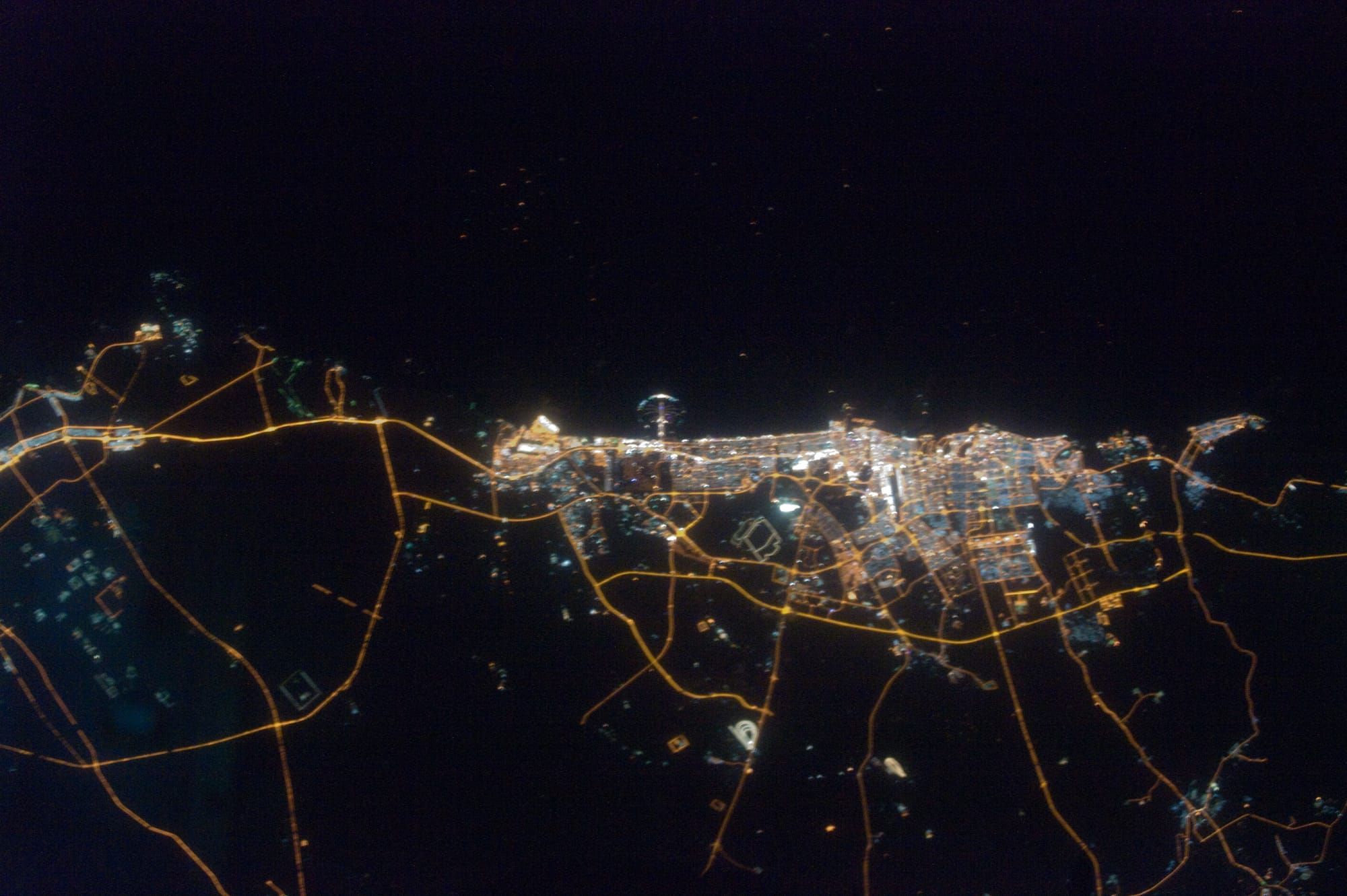
Cities and towns
In 2025, 45% of the world’s people lived in cities, 36% in towns and semi-dense areas and 20% in rural areas, by the UN estimate.
In 1950, 20% lived in cities. For 2050 the UN projects 48%.
Cities of a million people or more: 165 in 1975 and 511 in 2025. For 2050 the UN projects 611.
The largest city in 2025 is Jakarta (Indonesia), with 41.9 million.
Degree of urbanisation: one rule for every country, a city has at least 50,000 people at 1,500 or more per km². National definitions of “urban” differ.
| Rank | City | Country | Population |
|---|---|---|---|
| 1 | Jakarta |  Indonesia | 41,913,860 |
| 2 | Dhaka |  Bangladesh | 36,585,479 |
| 3 | Tōkyō (Tokyo) |  Japan | 33,412,512 |
| 4 | New Delhi |  India | 30,222,405 |
| 5 | Shanghai |  China | 29,558,908 |
| 6 | Guangzhou | China | 27,563,372 |
| 7 | Al-Qahirah (Cairo) |  Egypt | 25,566,102 |
| 8 | Manila |  Philippines | 24,735,305 |
| 9 | Kolkata | India | 22,549,738 |
| 10 | Seoul |  South Korea | 22,490,482 |
Sources: World Urbanization Prospects 2025, World Urbanization Prospects 2025, cities, UN DESA Population Division (CC BY 3.0 IGO).
Go further
Years up to 2025 are UN estimates. Later years are projections, the medium variant unless said otherwise. Methodology